How We're Getting Rid of Flock in Lafayette
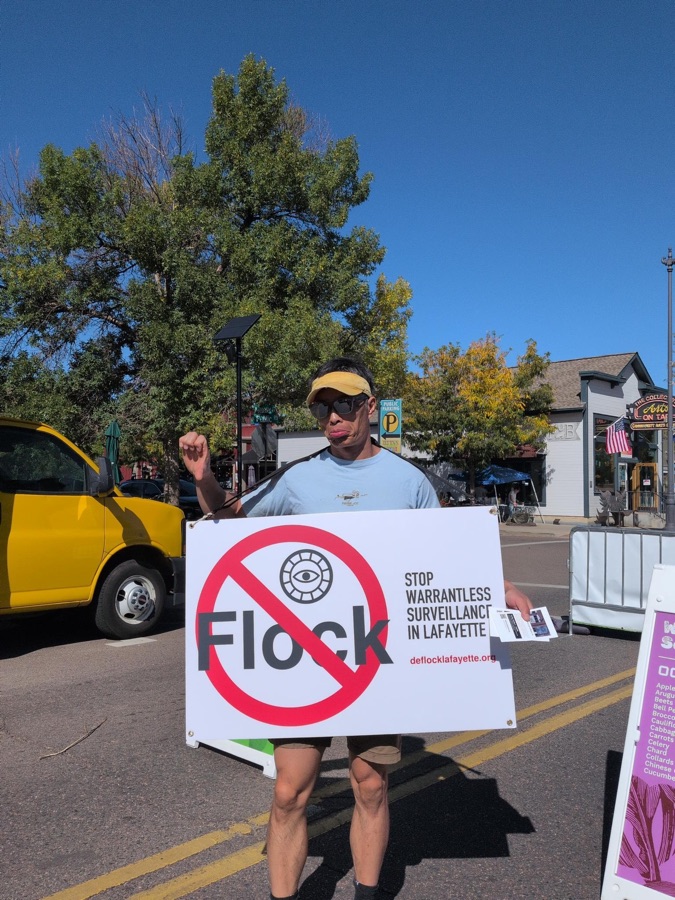
I first learned of Flock cameras in August 2026. Immediately, I saw it as a dangerous violation of our privacy, and researched how to take them down. A group of us started organizing in September, and by October 6, the city council voted to defund the contract, effectively ending its use pending a second vote on October 20. Our organizing drew what Lafayette's City Manager called "the largest community engagement I've seen in my 17-year career." Here's how we did it, for anyone who wants to do the same in their local community.
My background
I grew up in China where government surveillance is ubiquitous and government power is unlimited. Maybe that's why I'm sensitive to whenever our rights here are eroded. I had no experience in local politics, but I studied engineering and I'm also a trader, so I leaned on some of those skills in this work.
First I wanted to understand how the system works, so I'd know which knobs to turn. There are a lot of people who feel strongly about this topic, but most of them post on social media or sign a petition. I found out that the thing that moves the needle is getting people to show up at city council meetings, so that's what I focused on.
In trading, you're always trying different things to see what sticks. You have to be very honest with yourself and abandon ideas that don't work, no matter how much you like them. I took the same approach.
The main thing is, this was fun. I treated it like a hobby and a game. I wanted to win, but mostly I just wanted to play. It's fun to figure out how the game works, and try different approaches. Every time I learned a new detail about the contract, the history, or received an unsolicited email from someone offering to help, it was an adrenaline rush.
What I did
Find your people
In this document I use "I" a lot, because I want to give my perspective. But I could not have done this alone, and you shouldn't either.
- I joined a Signal group from deflock.org for Coloradans against Flock, and from there met a guy also from Lafayette.
- We started our own Signal group and invited other Lafayette residents focused on civil liberties to form a core group that strategized and coordinated.
- I talked to a neighbor, and it turned out he had experience dealing with city government, and helped us do research on Flock's impact on crime.
Understand city council process and dynamics
Flock is very good at getting city contracts because they know how the system works. They know it's a useful tool for police, and coach police departments on how to convince city council. They know council members are not experts and must rely on advice from full time staff. So it's an uphill battle for residents who have privacy concerns.
- I asked my neighbors who are active in city government for some tips. They told me to meet with city officials and the police, and I did.
- I studied the history of Flock in Lafayette by reading previous city council meeting minutes and video transcripts. And when I say "I," I mean Claude. I used it extensively for this project. I probably started by asking it, "how to get rid of Flock cameras." It sternly told me that cutting them down would be illegal. That was going to be Plan B -- just kidding.
- I met with a former mayor of the city because I saw she had voiced concerns about Flock recently in one of the meetings. She told me the way to move the needle is to get enough bodies in the city council meeting, so they feel where the community is.
Records requests
Every state has a public records law that lets anyone ask for government documents. In Colorado there are two: the Colorado Open Records Act (CORA) for city records like contracts, invoices and emails, and the Criminal Justice Records Act (CCJRA) for police records. You email the city's records office describing what you want, and they have to respond within a few business days. Small requests are often free. To find your state's version, search your state's name plus "open records request."
- I made CORA requests for the city's contract with Flock, which showed us the easiest way out (see "Force a vote" below).
- Under CCJRA, I also requested and received 3 months of search logs from the police. They were heavily redacted, but they did show the sheer number of searches on our system of 30 cameras, mostly by outside agencies. I was able to use this information in my city council speech.
Force a vote
In Lafayette, Flock was voted on only once, a five-year contract as part of a consent agenda, which is a bundle of routine items approved together without discussion. It renews automatically without any need for a vote. Basically, if no one did anything, Flock would continue. While the city did hold several public meetings on Flock, they were only informational. These meetings make people feel like they're doing something, but nothing changes if there is no action.
We targeted the October 6 meeting because the 2027 budget was on the agenda, and we pushed city officials to make Flock funding a separate item to be voted on by the city council. We did that by writing in and meeting with city staff. Having a Flock vote finally on the agenda made it easier to motivate residents to show up to the meeting.
Pack the room
Here's how we got people to show up at council meetings. At the October 6 budget meeting, about 80 residents came and 73 wrote in comments (72 against Flock, none for), and that carried the vote.
- I found everyone that commented on Flock from the council meeting packets and emailed them individually
- We posted on Reddit and Facebook to tell people about upcoming council meetings
- We passed out flyers at the farmers market. There was a Flock camera right there, so it was easy to start a conversation. But you have to stand up and walk around -- I sat with that sign for 30 minutes at a table and nobody came up to me until I put it on and paraded in the middle of an intersection. It's an awkward thing to do, but people were nice and it was effective. In a three-hour period I talked to no fewer than 100 people, and a lot of them showed up to the meeting.
Find a champion
We were lucky that one of the councilors, Kyle Beaulieu, was publicly and strongly against Flock, so we engaged with him to collaborate on how best to bring it to council, respect the process, and advocate for what the community wanted. It seemed clear to me that other councilors had concerns about Flock but weren't quite willing to stick their necks out.
Treat people with respect
I met with city councilors, the city manager, and the police department. I negotiated with the city on records requests and redactions. In every interaction, everyone was completely courteous. The chief of police invited me to a two-hour meeting where he wanted to make sure I understood how the system actually works. These are people who genuinely believe in the tool and only want to use it to solve crime. Even people who work at Flock just want to make a living. My beef is with the surveillance apparatus, never the people. I just don't want to support a system that incentivizes bad behavior. At the end of the day, if you let your ideology trump your humanity, then what's the point of all of this?
The result
On October 6, the city council meeting room was overflowing. About 30 residents spoke on Flock, and council voted 5-1 to stop funding, citing overwhelming community opposition. None of us are experienced organizers, and we did it on no budget and in our spare time. If we can do it, anyone can. You just have to care.
What's next
This is also not the end. Companies like Flock will always try to sell surveillance tech to the government, and police departments are going to be receptive. But the residents on the other side are dispersed and don't have the same financial incentives. We will try to pass a city ordinance modeled after the ACLU's Community Control Over Police Surveillance (CCOPS) model ordinance, so future mass surveillance attempts don't automatically slip in like Flock did.
If you're in Lafayette, come to the October 20 council meeting at City Hall (5:30 PM) to make sure the second vote goes through. Details on the main page.
Learnings
- I wish I knew how many people came from what source -- is it the farmers market? Social media? I should have asked "How did you hear about this?" on a sign-in sheet at the meeting, and used a different link or QR code for each flyer and post.
- We made a website and mailing list, but it turned out people tend not to sign up for them. I don't know how to build on the support we got, for ongoing organizing efforts. Maybe I should have asked people to sign up at the meeting, since they were fired up at that time. I'm going to get the emails from the written comments and contact all of them.